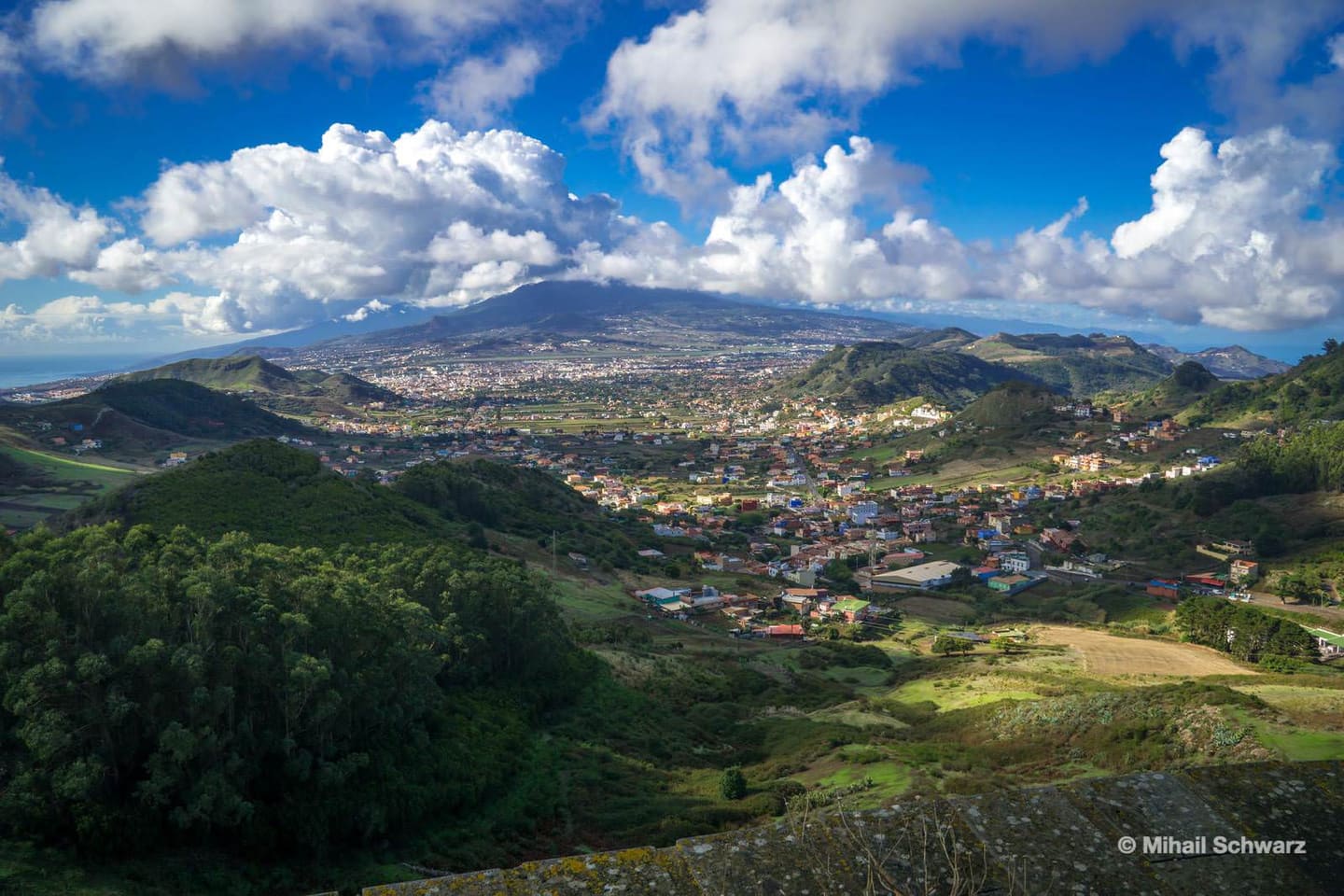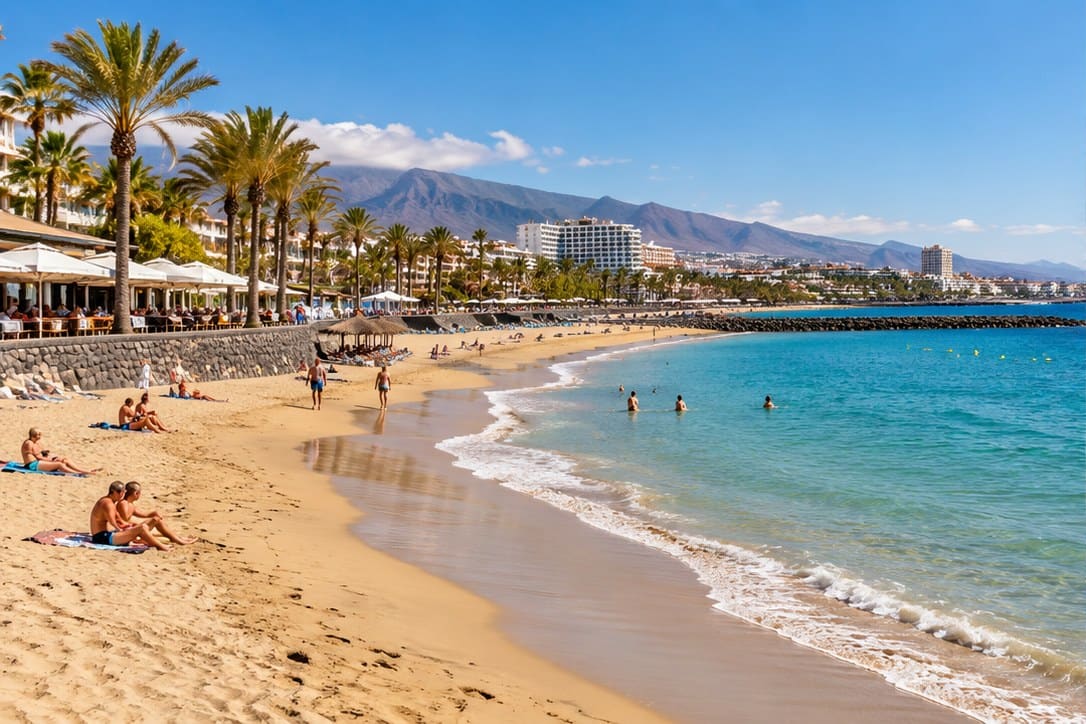
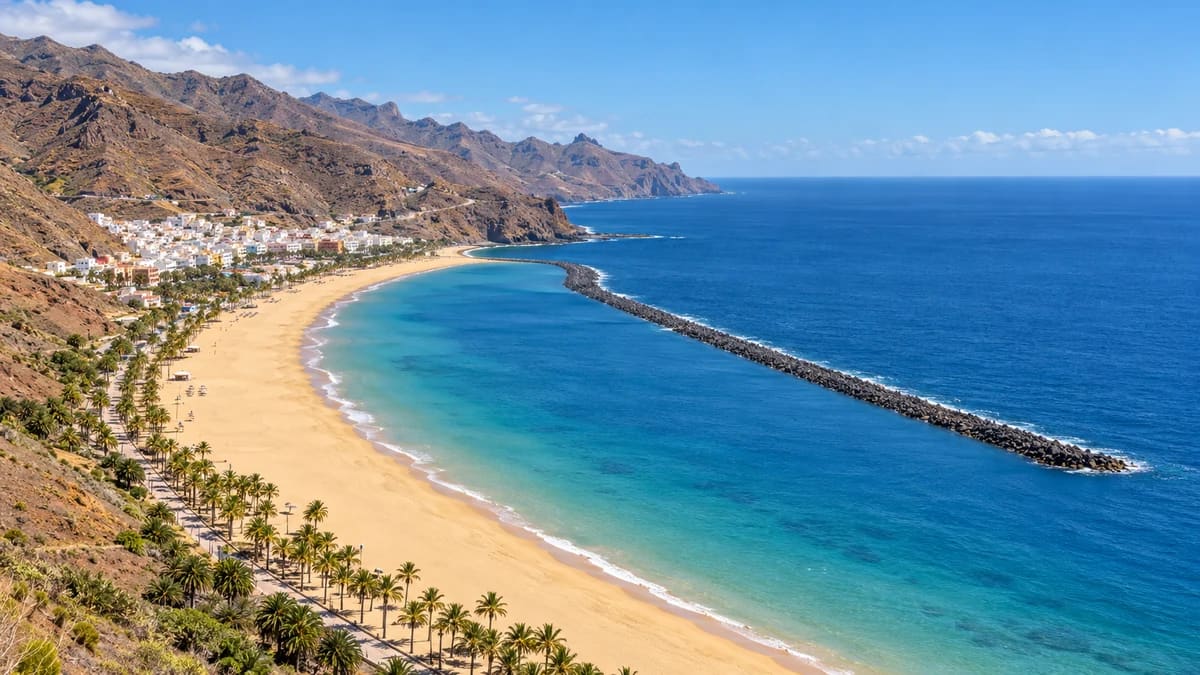
Playa de Las Teresitas is the golden sand beach beside San Andrés, just beyond Santa Cruz de Tenerife. I’d choose it for a relaxed swim and a fish lunch rather than surf or resort nightlife: the breakwater reduces the waves, bus 910 makes access straightforward, and the village gives you somewhere useful to go afterwards.
This is a beach worth planning around, but it isn’t a reason to promise yourself cloudless skies or an empty car park. Northern Tenerife has its own weather, and a sheltered bay still needs ordinary swimming precautions. The strongest combination is a beach morning, lunch in San Andrés and enough spare time to get home without racing a bus.
Why Playa de Las Teresitas has golden sand
The sand is the first clue that this coast has been reshaped. Tenerife’s volcanic landscape surrounds the beach, yet the broad strip beneath the palms is pale gold. Sand brought from the Sahara helped create the beach that opened in 1973; it wasn’t simply a naturally golden bay waiting to be discovered.
Santa Cruz’s official chronicler records five million sacks of sand, equivalent to 141,643 cubic metres, and gives the opening date as 15 June 1973. That is the documented figure I’d use rather than repeating the different tonnage estimates circulating in travel guides. The original shoreline included dark sand and stones, so the change was substantial.
The offshore breakwater matters just as much as the imported sand. It reduces the ocean swell reaching the bathing area and helps keep the beach in place. Look across the water and you can see the long protective structure; this is an engineered barrier, rather than a natural coral reef.
That history explains the beach’s appeal. You get pale sand and a gentler swimming setting against the hills of Anaga, without having to stay in a southern resort. It also explains why comparing Las Teresitas with a wild Anaga beach solely by photographs misses the point: they offer very different days by the sea.
For anyone searching for a golden sand beach near Santa Cruz, this is the practical choice. Come for space to sit, an easier entry into the water and the nearby village. If your priority is watching Atlantic surf break against black volcanic rock, use the Tenerife best beaches guide to compare the alternatives before travelling.
Swimming, snorkelling and beach safety
The breakwater usually makes Las Teresitas more manageable for swimming than the exposed coastline further into Anaga. The sandy approach into the water is useful for families, although children still need close supervision. Sheltered does not mean risk-free: wind, currents and changing conditions can affect the bay.
Read the flags when you arrive and follow the lifeguards’ instructions. A photograph showing flat water says nothing about the conditions during your visit. Don’t swim around the ends of the protective structure, climb onto the rocks or follow someone else into an area outside the supervised bathing zone.
Bring a snorkel if you enjoy looking beneath the surface, but treat it as an optional extra. Fish may be visible around rocky areas when the water is clear; a colourful underwater scene is not guaranteed. Stay away from the breakwater itself if reaching it means leaving the safe bathing area. Don’t feed wildlife or stand on marine life to steady yourself.
For a novice swimmer, I’d spend the first few minutes checking the entry and exit rather than immediately heading offshore. Keep your group together, agree a meeting point on the sand and choose a place where returning to shore is simple. A calm surface can encourage people to swim further than their ability warrants.
The Canary Islands health service’s September 2026 record listed the beach as suitable for bathing, with an excellent annual water-quality classification. Those are useful checks, but they don’t override a warning flag or temporary notice. Check the official bathing-water record before your trip if water quality concerns you.
Sun and wind deserve attention too. Take water, sunscreen and a hat; don’t assume the palms will provide shade wherever you settle. If the wind starts blowing sand across your towels, move or shorten the visit. Staying another hour simply because you drove across the island is rarely a good bargain.
Facilities, beach bars and free parking
Tenerife Tourism lists showers, toilets, changing facilities, sunbed and parasol hire, parking and accessible provision at Las Teresitas. That makes it a much easier outing than a beach reached by a steep staircase with nothing at the bottom. Still, check which facilities are operating when you arrive, especially if one service is essential to your visit.
For reduced mobility, confirm the accessible route and available assistance before committing to a particular beach entrance. A listed accessible beach doesn’t mean every parking space, patch of sand and route to the water is equally straightforward. Choose the entrance that meets your needs rather than following the nearest gap between palms.
The large parking area runs behind the beach, and the official tourism listing describes parking as free. That saves a separate parking budget, but it doesn’t guarantee a space at the time you want. Busy weekends and holidays are good reasons to arrive early or take the bus. Keep entrances clear and use designated spaces.
Beach bars, often called chiringuitos, are convenient for a drink or a simple bite. I’d use them for a short break and keep San Andrés for a proper lunch. Check the menu and prices first; neither a sea view nor a beach setting tells you what the final bill will be.
Sunbeds and umbrellas are optional paid extras, so ask for the current hire price before settling in. Bringing a towel gives you more flexibility if the hire area is busy. Pack what you need for the first hour instead of depending on finding an open kiosk immediately.
San Andrés: make time for a fish lunch
San Andrés is the village at the southern end of the beach, close enough to make lunch part of the outing. From the village end of the sand, reaching the first streets can be a short walk; from the far end, allow longer. The often-quoted “five minutes” depends entirely on where you start.
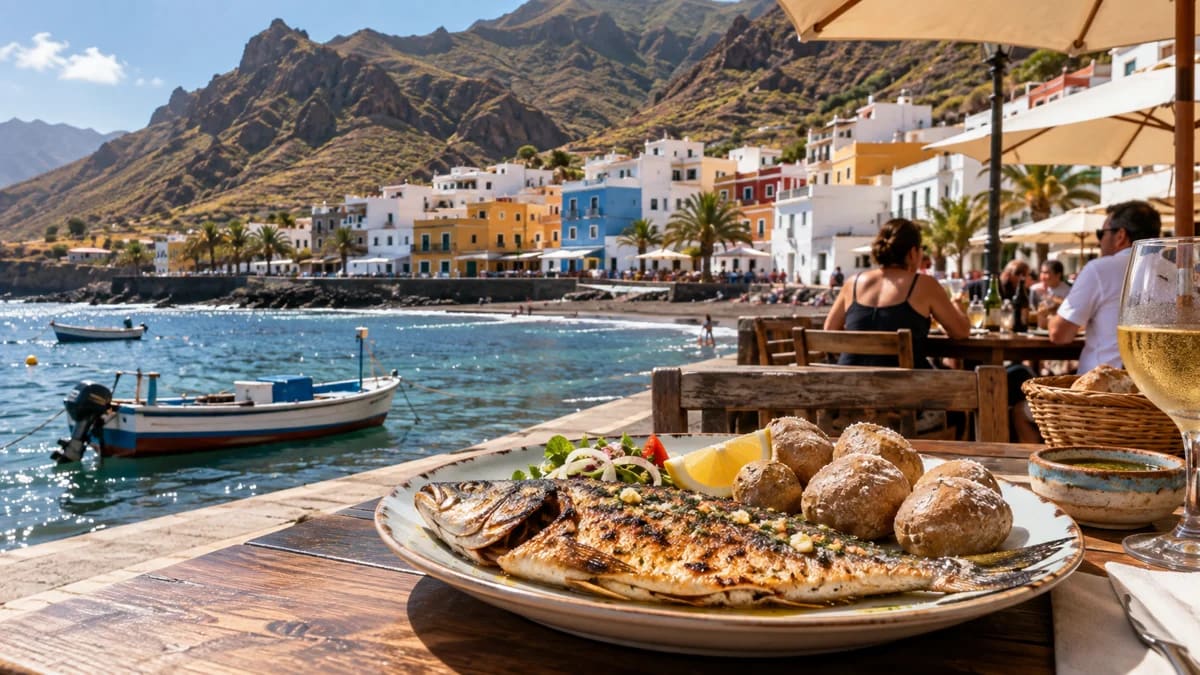
Look for fish dishes, squid and papas arrugadas, the small salted potatoes served with mojo sauce. Vieja, a local parrotfish, is a name you may see on menus; availability depends on the day’s supply. Ask what is available rather than treating any particular fish as a guaranteed speciality at every restaurant.
For a whole fish, clarify whether the price is per portion or by weight and ask what size suits your table. Confirm whether potatoes, salad and bread are included. These questions do more for a good-value lunch than relying on a list of “best restaurants” whose menus and ownership may have changed.
Choose by the current menu, opening hours and how the restaurant answers those practical questions. A smaller order of squid and potatoes can be a sensible alternative if you don’t want a long meal. If you have dietary requirements, ask before sitting down rather than assuming a seafood restaurant will have an equivalent alternative.
How to get to Las Teresitas: bus 910 or car
TITSA line 910 links Intercambiador Santa Cruz with Playa de Las Teresitas via San Andrés. The official timetable gives a journey time of about 20 minutes. Daytime departures are frequent, often around 10–15 minutes apart, but intervals and evening arrangements vary: check your date, direction and stop before leaving.
Use the official line 910 page, rather than a saved screenshot from an earlier holiday. Check the return journey as carefully as the outward one; some late timetable notes refer to San Andrés. Leave a buffer if you need to connect with another bus at the interchange.
From southern resorts, reaching Santa Cruz is a separate journey. Don’t read “20 minutes” as the total trip from Costa Adeje or Los Cristianos. Use the Tenerife buses guide to plan the connection, then weigh the travel time against spending the day at a closer beach.
By car, follow the coastal TF-11 from Santa Cruz towards San Andrés and the beach. The route is straightforward, but traffic can affect arrival. Save the return route before leaving, and allow time to walk from your parking space to your chosen stretch of sand.
I’d take 910 for a beach-and-lunch visit starting in Santa Cruz. A car makes more sense when the wider day includes other stops, provided you are comfortable with mountain roads. Don’t hire one solely because you assume Las Teresitas requires it. See the rental-car decision guide before booking.
Mirador de Las Teresitas: the view and the access catch
The familiar elevated view shows the curved beach, palms, breakwater and San Andrés together. It explains the geography far better than a photograph taken from your towel. The road towards Las Gaviotas rises above the bay, but a scenic position is not automatically a lawful or safe place to stop.
Treat access to the Mirador de Las Teresitas as conditional. Follow current signs, gates and barriers. Don’t climb a fence, enter a closed viewpoint or stop on a bend because a map pin or social-media post suggests it. A previously shared photograph is no proof that the same access is open now.
Use designated viewing and parking areas only. If no legal space is available, skip the stop; don’t improvise on a narrow verge. Walking up the road also needs a safe pedestrian route, so don’t assume you can simply leave the beach and follow the carriageway uphill.
If you want a wider scenic day, plan it with the Anaga guide and leave enough daylight for the return. The beach is an easy stop; mountain driving and walking take a different level of preparation. For a mixed group, I’d keep Las Teresitas as the main outing and add only a clearly accessible viewpoint.
Las Teresitas or the southern beaches?
| Your priority | Las Teresitas | Southern resort beaches |
|---|---|---|
| Easy visit from Santa Cruz | Direct 910 bus and nearby San Andrés | Longer journey across the island |
| Staying around Costa Adeje | A separate day trip | Easier to walk or take a short local journey |
| Swimming atmosphere | Breakwater shelter; check flags | Conditions vary by beach and protection |
| Lunch and evening plans | Village fish lunch | More resort dining and nightlife nearby |
| Surf or organised activities | Not the main reason to come | More activity choices in established resort areas |
Choose the extra that fits your day
Northern Tenerife excursions
Compare routes through Anaga and northern towns. Choose one that explicitly includes the stops you want; a “north tour” does not guarantee Las Teresitas. Check pickup, walking requirements and cancellation terms.
Compare day tripsCar hire for a wider itinerary
A car adds flexibility for several stops, but parking and mountain roads add work. Compare the full rental cost, excess, deposit and fuel policy; 910 remains the simpler option from Santa Cruz.
Decide whether to rentWater sports on another day
Use the established activity bases for guided kayaking, jet skis or surfing. Check departure location and ability requirements; these options should not be mistaken for services on Las Teresitas itself.
Compare water sportsFrequently asked questions
Is Las Teresitas free to visit?
There is no beach admission fee, and the official tourism listing describes free parking. Food and equipment hire cost extra. Check local parking signs on arrival.
Is Las Teresitas suitable for children?
The sheltered sandy bay is a sensible family option, with supervision and facilities. Follow flags, stay close to children and bring shade; the breakwater does not remove all swimming risks.
Can you get there without a car?
Yes. Take TITSA 910 from Intercambiador Santa Cruz, checking the current timetable and your return stop. From southern resorts, plan the separate connection to Santa Cruz.
Is the viewpoint always open?
Don’t assume it is. Respect closures and use only designated access and parking. Skip the photograph if getting it requires crossing a barrier or stopping unsafely.
Sources and your next step
Facts checked on 30 September 2026 against Tenerife Tourism’s beach listing, the TITSA 910 timetable and the Canary Islands bathing-water record linked above. Walking advice is an estimate, and facility availability should be checked on the day.
Choose your transport first, then leave room for lunch. For a visit from Santa Cruz, the beach and San Andrés already make a full enough day.