Choose the departure port and boat format before comparing Tenerife whale-watching prices. Puerto Colón is a practical starting point if you are staying around Costa Adeje; Los Gigantes may save a cross-island journey if you are based on the west coast. Neither port makes a sighting certain, and a longer ticket does not mean longer time beside the animals.
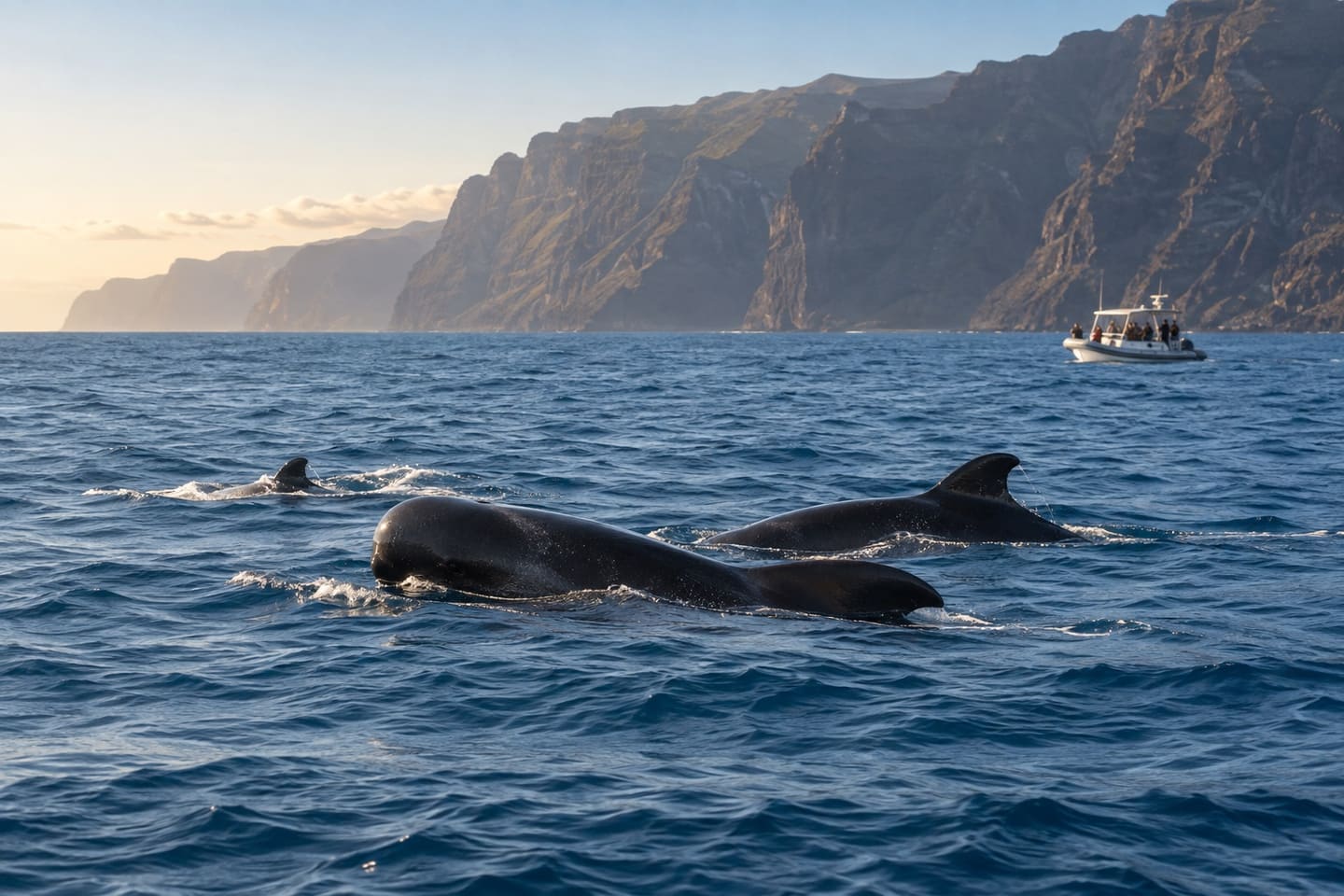
Check the vessel and its operating conditions, rather than assuming an “eco” label proves authorisation. Tenerife Tourism lists short-finned pilot whales and bottlenose dolphins as resident species, so whale watching is possible throughout the year. That describes the waters, not an appointment with wildlife on your sailing.
Choose your port before choosing a boat
Start with the departure marina and the exact meeting point on the booking page. A Puerto Colón tour and a Los Gigantes tour are different journeys before you even board. If you have a car, check the marina, pontoon and arrival time; if you need a transfer, confirm that it is included for your address. A tour title alone does not tell you where you must report.
Once the port works for your day, compare the itinerary. A two-hour wildlife trip can be the better choice when you want the guide’s attention and less time at sea. A longer cruise may add coastal scenery, food or a swim, but the Tenerife Tourism observation rules set a 30-minute maximum watching time near the animals. The extra hours are not extra guaranteed sightings.
Which departure works from your resort?
From Costa Adeje, inspect Puerto Colón options first. From a west-coast base, compare a Los Gigantes departure before committing to a south-coast transfer. If you are staying elsewhere, use the confirmation email to calculate the full journey to the named pontoon, not just the journey to the town. For a wider choice of activities from the south, see other boat trips in Tenerife; if the west coast is your base, read about staying in Los Gigantes.
Small boat, catamaran or private charter?
A small motorboat suits a group that wants a focused wildlife explanation. A catamaran can suit people who value deck space, food and a coastal cruise. A private charter gives your party its own booking, but the actual route and passenger limit still belong to the specific vessel. Do not infer a smooth ride, wheelchair access or a close encounter from the boat type alone.
The useful comparison is passenger cap, boarding conditions, trip length, what is included and the cancellation policy. For example, the Whale Watch Tenerife group tour advertises a two-hour trip from Puerto Colón with up to ten guests and marine-biologist guides. The White Paradise catamaran advertises three- and five-hour options from Puerto Colón with a much larger group. Those products serve different days; neither format gives you a right to closer wildlife viewing.
What a longer tour adds
Decide whether the additional time buys something your group actually wants. Freebird’s Masca and Los Gigantes trip advertises a 4.5-hour coastal itinerary with lunch and south-area transport, whereas Whale Wise’s tours describe a roughly two-hour wildlife trip with marine-biologist guides. Confirm the departure berth, inclusions and current booking terms on the product page. If you want a different south-coast departure, compare excursions from Los Cristianos separately.
| Product | Format and advertised duration | Departure to verify | Deciding detail |
|---|---|---|---|
| Whale Watch Tenerife group tour | Small group · 2 hours | Puerto Colón, exact dock on voucher | Up to 10 guests; guide with a marine-biology focus |
| White Paradise | Catamaran · 3 or 5 hours | Puerto Colón, dock on booking page | Up to 74 passengers; no hotel pick-up advertised |
| Whale Wise Eco Tour | Small boat · about 2 hours | Confirm marina and berth when booking | Marine-biologist guides; west-coast wildlife focus |
| Freebird Masca and Los Gigantes | Catamaran · 4.5 hours | Confirm marina and transfer stop | Cliff route, lunch and south-area transport advertised |
The operators publish different prices, age rules and cancellation terms, and one operator’s pages can disagree. Compare the live checkout for your date and party rather than treating a price or rating copied into a guide as a promise. The links above lead to the named products; they are not a ranking of licensed vessels.
What responsible whale watching means here
Tenerife Tourism’s rules for watching cetaceans tell boats to stay at least 60 metres away, limit observation to 30 minutes, slow down and leave if animals are disturbed. Swimming with, feeding and touching the animals are prohibited. A separate coastal swim stop on a cruise is a different activity and must take place away from the cetaceans.
The Canary Islands Government describes the Blue Boat (Barco Azul) flag as a vessel marking linked to whale-watching authorisation. The island’s Sustainability Quality Charter is a voluntary commitment by companies and is not a substitute for checking that vessel’s operating authorisation. Ask for the boat’s name and current authorisation when you book; do not take a marketing badge or a marketplace rating as proof. Resident pilot whales and bottlenose dolphins make the area interesting, but they do not guarantee a sighting on a particular departure.
Wildlife is not a scheduled attraction
The guide may alter course because of sea conditions or the animals’ location, and an ethical operator may keep its distance or move away. That is part of the trip, not a failure to deliver a close-up photo. If your main aim is cliff scenery or a swim, choose a coastal cruise for those features and treat wildlife as a welcome possibility.
Weather, accessibility and group restrictions
Sea state can change the route or stop a departure. A larger catamaran and a smaller motorboat also board differently; neither boat type alone tells you whether it works for a wheelchair, pushchair or someone who finds steps difficult. Check the actual vessel and boarding point with the operator before paying, especially if your party needs seats together or help getting aboard.
Read the product’s age and health restrictions for your group. They vary between vessels; the small-group Whale Watch Tenerife listing, for example, excludes children under three, pregnant passengers and people with certain neck, back or recent surgery concerns. These conditions do not automatically apply to the catamaran. If motion sickness is a concern, ask the operator about the expected sea state and speak to a pharmacist about any medicine. A tour comparison cannot decide medical suitability for you.
If the sea forecast changes
Contact the operator using the details on your voucher before travelling to the marina. Ask whether the sailing is going ahead, whether a different time is offered and what the booking terms say about a refund. An operator’s weather cancellation is different from your own decision not to travel; check both clauses. The charter badge does not define either policy.
Book the trip that fits your group
Choose your port first, then decide whether your group wants a focused small-boat trip or a longer shared cruise. Compare the named vessel, passenger cap, boarding arrangements and the precise experience being sold. Before paying, verify the boat’s authorisation and read the cancellation terms. This is more useful than choosing the cheapest headline price without its conditions.
If a guided wildlife trip is the priority, compare the small-group products directly. If a swim, food and coastline matter as much as wildlife, inspect the longer catamaran itinerary. Keep in mind that a resident species is not a guaranteed sighting and a voluntary Quality Charter is not an operating licence. You can plan your Tenerife trip around the port you choose.
Before boarding
Save the voucher and check its marina, pontoon, meeting time and operator contact. Bring sun protection and water, and dress for wind at sea. If the itinerary includes a swim, remember that the wildlife-watching rules still prohibit swimming with cetaceans. Ask about any accessibility or health concern before arriving at the boat; the crew can explain the conditions of that specific sailing.
Frequently asked questions
Are whales guaranteed on Tenerife tours?
No. Tenerife Tourism describes short-finned pilot whales and bottlenose dolphins as resident species, meaning they are present in local waters throughout the year. That does not guarantee that any one boat will find them. Some operators advertise a return-trip policy if there is no sighting; read that product’s terms rather than treating the policy as a wildlife promise.
Which port is best for whale watching?
The best port is the one that works with your base and the product you want. Puerto Colón is convenient for many Costa Adeje stays; Los Gigantes can make more sense from the west coast. Check the actual meeting point and travel time before comparing prices. The animals and the observation rules do not change to suit a marina.
Does a Quality Charter replace an operating authorisation?
No. Tenerife’s Sustainability Quality Charter is a voluntary company commitment. Operating authorisation applies separately to the vessel used for whale and dolphin watching. Ask the operator for the boat’s name and current authorisation, then compare the charter’s environmental commitments if they matter to you. Neither a badge nor a review score proves that your particular sailing is authorised.
Before you book or set out
If you want wildlife interpretation, start with a small-group trip whose port and boarding conditions work for you. If the day is also about the coast, compare the longer catamaran. In either case, verify the vessel, meeting point and cancellation terms, and allow for a trip that observes wildlife at a respectful distance.
Sources
- Tenerife Tourism: resident cetacean species
- Tenerife Tourism: whale-watching rules
- Tenerife Tourism: Sustainability Quality Charter
- Canary Islands Government: whale-watching authorisation and Blue Boat marking
- Whale Watch Tenerife: group tour
- White Paradise: excursion details
- Whale Wise Eco Tour: tours
- Freebird: experiences